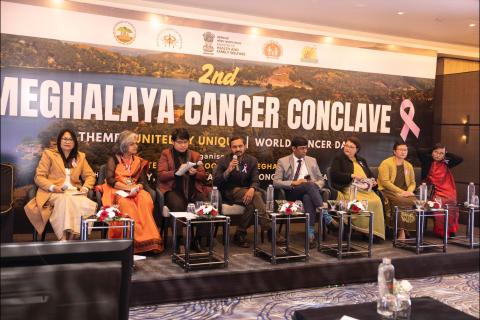
Shillong, 4th February 2026: The Meghalaya government has doubled down on its vision for a healthier, cancer-free state, unveiling a robust strategy focused on prevention, early detection, decentralized care, and community involvement at the 2nd Meghalaya Cancer Conclave.
The flagship Meghalaya Mission for Cancer Prevention and Early Detection marks a pivotal shift from reactive treatment to proactive health preservation. By emphasizing timely screenings and lifestyle changes, the initiative targets root causes like tobacco use— a major factor in Meghalaya's high incidence of tobacco-related cancers.
Officials highlighted challenges such as delayed diagnosis, low awareness, and stigma, which have led to preventable deaths despite early-stage treatability.
In a video address, Chief Minister Conrad K. Sangma emphasized screening the eligible population early and ensuring no one battles cancer alone. Key highlights include:
Nearly 9% of the state budget allocated to healthcare, minimizing out-of-state treatments.
Strengthened cancer services at Civil Hospitals in Shillong and Tura, offering free chemotherapy, radiotherapy, surgical oncology, palliative care, and counseling.
New cancer wings with advanced equipment like linear accelerators, Brachytherapy machines, and CT simulators under installation.
Free diagnostic tests and essential cancer medicines for all patients.
Addressing the Cancer Burden: Stats and Challenges
Health Minister Wailadmiki Shylla underscored the state's heavy cancer load:
177 cases per 1 lakh men and 96 per 1 lakh women (vs. national average of ~100).
East Khasi Hills reports alarmingly high rates.
NFHS-5 data reveals dismal screening rates:
0.6% for cervical cancer (women 30–49).
0.5% for breast cancer.
0.4% for oral cancer.
A two-year pilot screened 2,342 individuals, detecting 28 early-stage cases. Yet, optimism prevails with 377 cancer survivors (many Stage III/IV) and success stories like a Nongstoin child treated successfully from infancy.
Principal Secretary of Health Sampath Kumar noted East Khasi Hills' 228 cases per 1 lakh males, blaming late detection.
Solutions include:
Upgrading district hospitals.
Strengthening referrals and oncology training.
Travel aid for remote patients.
District-level treatment facilities to decongest Shillong hospitals.
Key Launches and Initiatives
The conclave saw major rollouts:
Field implementation of the Meghalaya Mission, including a cancer screening app and diagnostic devices.
Statewide HPV testing for cervical cancer prevention.
Cancer control project with Grace Cancer Foundation in West Khasi Hills.
Additional milestones:
Release of the Health Atlas by State Health Systems Resource Centre.
Felicitations for top NP-NCD districts.
The event, addressed by Chief Secretary Shakil P Ahammed and senior officials, signals Meghalaya's all-out war on cancer through awareness, access, and action.
Stay tuned for updates on Meghalaya's health initiatives.


 Skip To Main Content
 Screen Reader Access